
Safeguarding
Click here to go to the Safeguarding Page for Children
Click here to go to the Support for Families Page
All stakeholders at Ruswarp are firmly committed to safeguarding our school children and families. Staff engage in regular safeguarding training in order to ensure our children and families are well supported and protected from harm.
Our approach to safeguarding is underpinned by our commitment as a Church school to ensure that our school community is encouraged to 'Think for Yourself and Act for Others'. For further information about safeguarding at Ruswarp, please refer to our information leaflet:
Key safeguarding contacts at Ruswarp are:
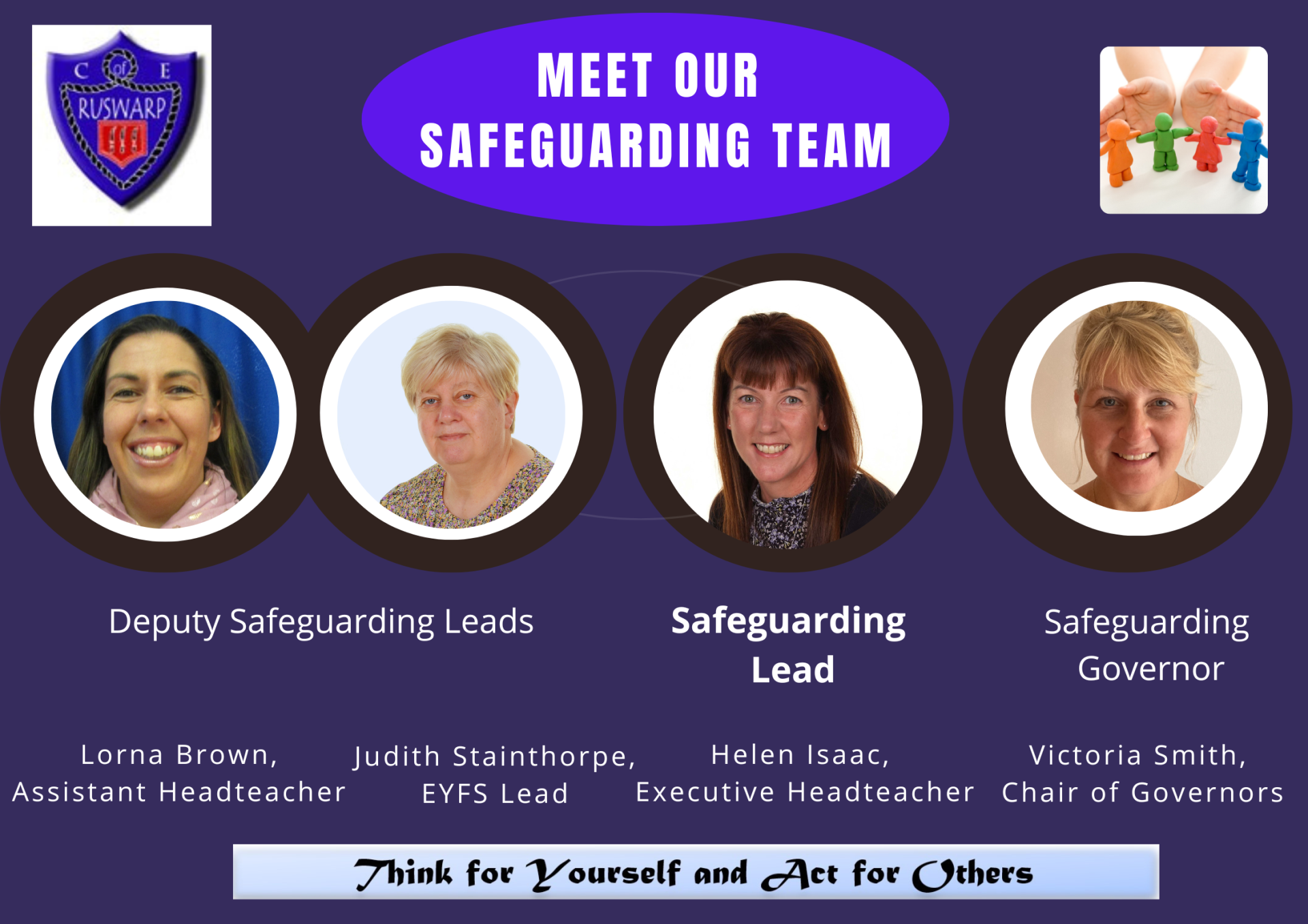
The Executive Headteacher, Helen Isaac: the school's Designated Safeguarding Lead (DSL).
Contact: 01947 602029/admin@ruswarp.n-yorks.sch.uk
The Assistant Headteacher, Lorna Brown: Deputy Designated Safeguarding Lead.
Contact: 01947 602029/admin@ruswarp.n-yorks.sch.uk
The Senior Teacher, Judith Stainthorpe: Deputy Designated Safeguarding Lead.
Contact: 01947 602029/admin@ruswarp.n-yorks.sch.uk
Victoria Smith: the school's safeguarding governor.
Contact: 01947 602029/CofG@ruswarp.n-yorks.sch.uk
Reporting Concerns
If you have any child protection or safeguarding concerns, our safeguarding team can help.
You can also contact Children's Social Care Contact Centre on 0300 131 2 131 or http://www.safeguardingchildren.co.uk for more information or to make a report.
If you are experiencing online bullying or something else online has worried you please speak to an adult you trust, or you can talk to Childline at any time:
0800 1111 or www.childline.org.uk.
Safeguarding Practice
We have a wealth of safeguarding information to support families on our dedicated webpage which can be found here: Support for Families
It is important for parents to be aware that staff and volunteers in the school have a duty to report concerns about a child, whether this means the child may be in need of additional support or help of some kind or whether it is thought that a child may have been abused or be at risk of abuse.
There are four categories of abuse: physical, sexual, emotional, neglect.
In some cases, the school is obliged to refer children to Children’s Social Care staff, for children to be assessed for their needs or if an investigation into possible child abuse is required. In many cases, there will already have been discussions between school staff and the parents of the child, and the situation and concerns will not be a surprise to the parents.
However, parents may not be told that the school has referred their child to Children’s Social Care if it is thought that this might put the child at risk.
If school staff need to express concerns about a child or refer a child to Children’s Social Care, it is appreciated that this can cause distress or anger for the child’s parents/carers. It is important however, that all parties – parents and school staff – try to discuss these matters as reasonably as possible so that the best interests of the child can be secured.
Children’s Social Care also tries to carry out its enquiries sensitively. It has to gather information with parents about the steps being taken and it is therefore beneficial that discussions are as open and as constructive as possible.
Safer Recruitment
We carefully check that all staff and volunteers are safe to work with our children. A number of checks are made including DBS checks, references, ID and employment history. We keep a single central record of all this information and this is regularly monitored.
Visitors and volunteers are rigorously checked in much the same way staff are before they can have any unsupervised access to our children. Any contractors on site have to read a safety briefing before being signed into the building. All adults in school wear an ID badge with a coloured lanyard for quick identification.
Safeguarding Policies at Ruswarp
We work closely with families and other agencies to ensure the safeguarding of children. Underpinning our work is a collection of safeguarding policies and procedures. These policies form part of our statutory duties to safeguard all children. They have been updated to reflect the latest national guidance for safeguarding, as detailed in "Keeping Children Safe in Education" (2025).
Please click on the link below to access all of our policies, including our safeguarding policies:
Further Safeguarding Documents
Keeping Children Safe in Education
Working Together to Safeguard Children
Attendance and Safeguarding at Ruswarp
Please support us by ensuring that your child attends school regularly – this is a parent's legal responsibility. Failing to attend school regularly may be considered a safeguarding matter. Any absence affects the pattern of a child’s schooling and regular absence will seriously affect their learning. We are always happy to discuss any concerns about attendance and we can offer tailored support to help to remove barriers. (Further details can be found on our dedicated webpage below:AttendanceIt is vital that parents inform us promptly regarding any absence - whatever the reason. This should be before 8.45am on every day of absence. We have robust safeguarding procedures for following up any unexplained absence, which includes home visits and requesting police welfare checks where necessary.
Behaviour and Safeguarding at Ruswarp
Our Positive Behaviour Policy details the three school rules which our children are taught from their earliest days with us: Be Ready, Be Respectful, Be Safe. Staff make regular reference to the three rules and help children to understand them and apply them to everything they do because they help us all to learn in a calm and safe environment and to become responsible citizens.
We recognise that all children make mistakes and we support them to make the right choices and to make amends for any wrong decisions. Our policy also details the consequences of poor choices because this is how we learn to take responsibility for our actions. In very rare cases, this could include permanent exclusion.
Where a child or children's behaviour is considered to present a safeguarding risk, our Positive Behaviour Policy clearly details the procedures we will take to address this.
Bullying and Safeguarding at Ruswarp
Bullying is the repetitive, intentional hurting of one person or group by another person or group, where the relationship involves an imbalance of power. Bullying can be physical, verbal or psychological. It can happen face-to-face or online.
Definition from The Anti-Bullying Alliance
Bullying is an important safeguarding issue. It is more than a friendship disagreement. The impact of bullying can severely affect a child or young person - both in the short and long term. Our Anti-Bullying Policy details the procedures we have in place, to prevent bullying happening in the first place and to deal with incidents of bullying, as well as detailing how we support children to identify and report bullying. When there is `reasonable cause to suspect that a child is suffering, or is likely to suffer significant harm', a bullying incident will be addressed as a child protection concern.
Protected Characteristics and Safeguarding at Ruswarp
At Ruswarp, safeguarding is deeply integrated with our commitment to equality and inclusion, ensuring that education on protected characteristics underpins our proactive approach to creating a safe, respectful, and supportive environment for every child.
We work to ensure that our children understand that:
- There are no outsiders at Ruswarp
- Everyone is different
- We celebrate our differences
- We are all equal in our differences
The Equality Act became law in 2010. It covers everyone in Britain and protects people from discrimination, harassment and victimisation. Everyone in Britain is protected. This is because the Equality Act protects people against discrimination because of the protected characteristics that we all have. Under the Equality Act, there are nine Protected Characteristics:
- Age
- Disability
- Gender reassignment
- Race
- Religion or belief
- Marriage or civil partnership
- Sex
- Sexual orientation
- Pregnancy and maternity
At Ruswarp, we seek to help our children understand their responsibilities concerning the protected characteristics, to gain an understanding of the world they are growing up in and to learn how to live alongside, and show respect for, a diverse range of people. We help our children to apply their developing understanding to identify any forms of discrimination which they might notice in school or in the community and we take appropriate action to deal with those concerns.
Health and Safety and Safeguarding at Ruswarp
We work hard to ensure that our facilities are as safe as possible. Premises checks are completed every day and the building is maintained to the highest standards. External experts come regularly to check things like the firefighting equipment, electrical equipment, water systems and security lights are in perfect working order. The premises are accessible to pupils, parents and staff with disabilities. We carry out regular fire alarm and evacuation tests and all of this is recorded in our Fire Log. An annual Fire Audit and risk assessment reviews are carried out regularly.
Our catering facilities meet the highest standards of hygiene and they are checked regularly by officers from NYC. We also meet the nutritional standards in place nationally and we are careful about the food of all pupils with allergies.
We have worked closely with the Local Council and our School Crossing Patrol, Claire, on road safety initiatives to help pupils stay safe before and after school too.
The Health & Safety team includes a member of the Governing Body. The team regularly discuss all matters of Health and Safety, Safeguarding and Security. The school complies with all national and local Health & Safety Regulations.
Safeguarding in the Curriculum at Ruswarp
At Ruswarp, we provide a safe, secure, and nurturing environment where every child feels protected and valued. We take a proactive approach to safeguarding by continuously adapting it to address emerging risks—whether local, national, or online—ensuring our children are well-prepared to navigate today’s challenges safely.
Our comprehensive PSHE (Personal, Social, Health and Economic) curriculum covers vital topics including Domestic Violence, Drug and Alcohol Awareness, Bullying, Personal Safety, Inappropriate Touching, Secrets, Relationships, Cyberbullying, and Online Security. We empower children with clear guidance on how to report any concerns or situations that make them feel uncomfortable, fostering a culture of openness and trust.
We also collaborate with trusted external partners, such as the NSPCC, to deliver key safeguarding messages in engaging and memorable ways. For example, our use of the NSPCC’s `Pantosaurus' programme helps children understand important safety concepts in an accessible and impactful manner.
Online Safety at Ruswarp
We have an e-safety team in place at Ruswarp who actively promote and monitor e-safety. We carry out an annual e-safety audit and this supports our comprehensive in-school policy. All pupils, staff and visitors to school must read and sign our Acceptable Use Policy before any access to our systems is allowed. All usage is monitored by specialist software and this is backed up by a robust firewall and web filtering system. Pupils are taught how to stay safe online and this is regularly reinforced in Computing lessons. Children are also taught what to do and who they can talk to if they are worried.
Operation Encompass
At Ruswarp, we are working in partnership with North Yorkshire Police to identify and provide appropriate support to pupils who have experienced domestic violence in their household; this scheme is called Operation Encompass.
The purpose of Operation Encompass is to safeguard and support children and young people who have been involved in or witnessed a domestic abuse incident.
Domestic abuse impacts on children in a number of ways. Children are at increased risk of physical injury during an incident, either by accident or because they attempt to intervene. Even when not directly injured, children are greatly distressed by witnessing the physical and emotional suffering of a parent.
Operation Encompass has been created to highlight this situation. It is the implementation of key partnership working between the police and schools. The aim of sharing information with local schools is to allow ‘key adults’, such as the Headteacher, Assistant Headteacher and Class Teacher or named Support Staff, the opportunity of engaging with the child and to provide access to support that allows them to remain in a safe but secure familiar environment.
In order to achieve this, the Multi-Agency Safeguarding Team will share police information of all domestic incidents where one of our pupils has been present, with the Designated Safeguarding Lead(s) (DSL).
On receipt of any information, the DSL will decide on the appropriate support the child requires. We will record this information and store this information in line with our Safeguarding Policy.
Further information can be found by clicking on the following link:
Early Help
The aim of Early Help is to build on people’s capacity and resources to manage their own dilemmas, resolve their own difficulties and prevent further problems in the future. Early Help is the response offered by all services in North Yorkshire who are in contact with children, young people and families when an unmet need is identified as outlined in Working Together to Safeguard Children (2023).
North Yorkshire Safeguarding Information for Parents
CEOP Information for Parents
CEOP is a command of the National Crime Agency and is dedicated to tackling the sexual abuse and exploitation of children and young people. CEOP helps children and young people under the age of 18 who have been forced or manipulated into taking part, or are being pressured to take part, in sexual activity of any kind. This can be both online and offline.
The CEOP Safety Centre offers information and advice for children and young people, parents and carers and professionals. You can visit the CEOP Safety Centre and make a report directly to CEOP by clicking the CEOP button. See link below:
Online bullying or other online concerns should not be reported to CEOP and children and young people should be directed to speak to an adult they trust, and/or referred to Childline, if they would like to speak to someone about how they are feeling.
CEOP Information for Young People
CEOP helps any child or young person under the age of 18 who is being pressured, forced or tricked into taking part in sexual activity of any kind. This can be something that has taken place either online or in ‘the real world’, or both. The CEOP Safety Centre has clear information and advice on what can be reported to CEOP, the reporting process and what will happen if you do decide to make a report. See link below.